Portfolio Development
Design Portfolio Guide Build a clear case for your work
Choose the evidence, structure, and project stories that help the right person understand what you can do—and why it matters.

The short version
- Make a case: A portfolio is selected evidence for a role, not an archive of everything you have made.
- Separate the layers: The portfolio shell helps people choose where to go; each project page proves something specific.
- Design for two depths: Give fast readers the argument and interested readers the evidence behind it.
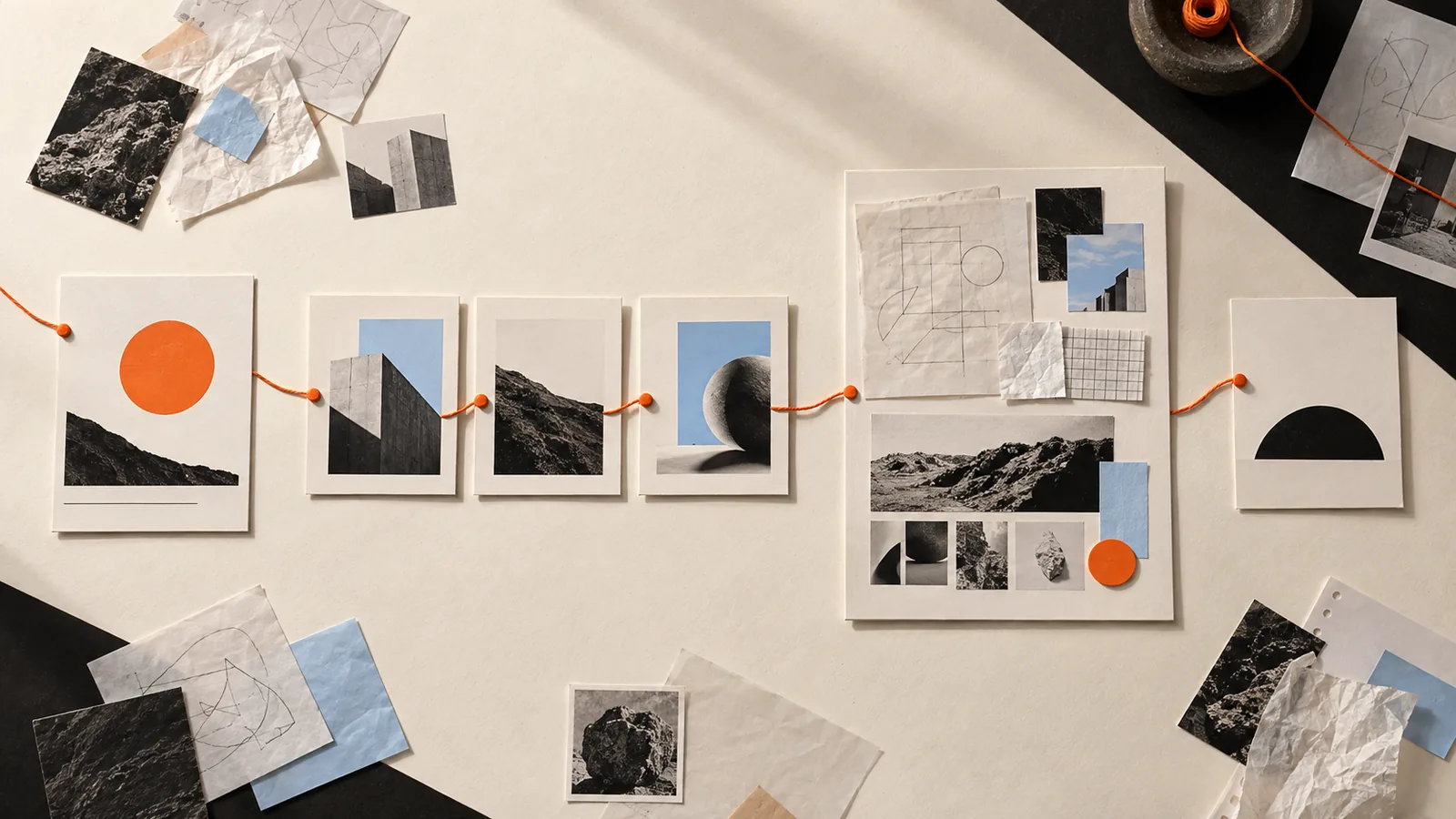
Start with the role, not the template
A portfolio is not a neutral container. It is an argument that the work you have done prepares you for the work you want to do next. That argument changes with the role, level, discipline, and person reading it.
Before redesigning the site, collect a small set of role descriptions or client briefs that genuinely interest you. Look for repeated expectations: systems thinking, visual craft, research, facilitation, motion, shipped product work, brand expression, technical fluency, or something else. Your portfolio does not need to claim all of them. It needs credible evidence for the ones that matter to your direction.
Translate the role into portfolio evidence
- The role values systems thinking
- Show how one decision affects a larger product, service, brand, or component system.
- The role values visual craft
- Use details, states, typography, composition, and production choices as evidence—not only polished overview images.
- The role values collaboration
- Name your contribution, the other disciplines involved, and how the work changed through disagreement or new evidence.
- The role values outcomes
- Connect the work to a verifiable result, behavior, decision, or learning. Do not invent metrics to make the story sound complete.
Build a portfolio shell that helps people choose
The portfolio shell is the experience around the project pages. It tells a reader who you are, what kind of work is here, which project to open, and how to continue the conversation. It should not make every visitor read every case study in order to understand you.
- Homepage
- State the role or kind of work, introduce the strongest relevant projects, and make the next action visible.A short, specific introduction is more useful than a broad claim that could describe any designer.
- Project selection or index
- Use titles, short context, and representative images that help readers predict what each project will prove.A thumbnail grid should support a decision, not become a memory test.
- Navigation
- Keep the primary routes stable and make it easy to return from a project to the selection.
- About and resume
- Connect your background and experience to the work without repeating the same biography in three places.
- Contact
- Provide a clear, working way to reach you and enough context for what kind of conversation you welcome.
Choose the fewest projects that prove the case
There is no universal three-to-five-project rule. Count the distinct claims you need to support, then choose the strongest project for each. A project earns its place when it adds relevant proof that the rest of the portfolio does not already provide.
What each project should add
- A clear connection to the role, client, or kind of problem you want next.
- A level of craft and judgment you are comfortable being hired to repeat.
- A distinct problem, medium, scale, constraint, or contribution.
- Enough evidence to separate your work from the team’s work and the final mockup from the actual decision.
- A reason to keep reading after someone has seen the projects before it.
Archive logic
Include it because you made it
Portfolio logic
Include it because it proves something
Write case studies as useful arguments
A case study is not a diary of every activity and it is not a gallery of unexplained screens. It helps a reader understand what changed, what you contributed, which decisions mattered, and what evidence supports the result.
- 1Open with the project in one screenName the problem, audience, your role, the outcome or current state, and one representative image. Let this overview stand on its own.
- 2Establish the constraintsExplain the team, timeline, platform, business, content, accessibility, production, or research conditions that shaped the work.
- 3Select the consequential decisionsShow a few moments where the work could have gone another way and explain why you chose this direction.
- 4Pair claims with evidencePlace research, iterations, interface states, production details, results, or stakeholder decisions beside the claim they support.
- 5Name the outcome honestlySeparate measured results, observed behavior, approved direction, shipped work, and what remains untested.
- 6End with what changed in your thinkingA useful reflection names what you would preserve, revisit, or investigate next—not a generic lesson about communication.
If your project notes are still scattered, the free Design Case Study Builder can help you find the problem, decisions, evidence, and outcome before you write the polished page.
Show proof at the point of the claim
“I improved the experience” asks the reader to take your word for it. Proof can be quantitative, qualitative, visual, technical, or organizational. The right kind depends on the claim.
- You claim clearer hierarchy
- Show the before and after at a readable scale and point to the decision that changed the reading order.
- You claim better usability
- Share the task, observed behavior, method, sample limits, and what changed after the test.
- You claim business impact
- Define the metric, timeframe, baseline, and your project’s plausible contribution.
- You have no outcome metric
- Use the strongest honest evidence available: approval, launch, adoption, fewer support questions, design-system use, stakeholder learning, or a clearly named hypothesis.
- The work was collaborative
- Name what you owned, what others contributed, and which decisions you influenced together.
Design for a fast scan and a deeper read
You do not know how many minutes a specific reader will give the portfolio. Design the page so the central argument appears quickly, then make the supporting evidence easy to inspect without flattening everything into a summary.
- Use one clear page title and descriptive section headings.
- Keep the project overview visible before the long process narrative.
- Write captions that explain why a visual matters instead of repeating what it shows.
- Crop and size images so the relevant detail can actually be read.
- Keep body text, labels, and navigation comfortable across mobile and desktop.
- Use motion to explain or demonstrate the work, with controls and a useful still state.
- Let typography support the project instead of turning every section into a new style experiment.
If the type system is the unresolved piece, use the Font Pairing tool to compare a focused set of real combinations with your own content.
Choose a platform you can maintain
The best platform is the one that supports your evidence, your level of control, and the work you want to demonstrate without making every update a separate engineering project.
- You need to publish quickly
- Choose a reliable hosted builder with responsive templates and enough control over structure, metadata, images, and accessibility.
- Interaction is part of the proof
- Choose a tool that can represent the motion or behavior well, then provide a static explanation for readers and devices that cannot run it.
- Front-end craft is part of your role
- A custom build can become evidence, but only if the result is fast, accessible, and maintainable.
- You expect frequent updates
- Favor a system you can edit confidently, reuse across projects, and hand off to your future self.
Make the portfolio usable and findable
Accessibility, performance, and search are not separate polish passes. They determine whether someone can reach the work, understand it, and continue.
Before you publish
- Use a unique, accurate page title and one clear main heading for every project.
- Write useful link labels and keep important navigation in real links that can be followed.
- Add alt text when an image carries meaning; use nearby text and captions for richer project context.
- Meet WCAG 2.2 requirements for keyboard access, focus, contrast, structure, and alternatives relevant to the page.
- Compress and size images for their rendered context instead of loading portfolio masters into thumbnails.
- Check Core Web Vitals with field data when available; use lab tests to diagnose, not to invent a universal experience.
- Test the primary paths on a phone, a keyboard, a slower connection, and a fresh browser.
- Make the resume and contact path available without forcing a download or form submission.
Use the portfolio accessibility guide and portfolio SEO checklist for the deeper checks.
Get feedback at the right level
“Review my portfolio” can mean several different jobs. A reader may be evaluating the portfolio shell, the quality of the selected work, one project story, the visual system, the resume, or role fit. Name the layer so the feedback can go deep enough to help.
Portfolio shell
Can the right person find and understand the work?
Project interior
Does this project prove the claim it makes?
Run the final portfolio audit
- The opening makes the intended role or kind of work understandable without a generic superlative.
- Every featured project adds distinct, relevant evidence.
- Project cards help readers predict what they will find before clicking.
- Each case study separates context, contribution, decisions, evidence, outcome, and honest limits.
- Claims appear beside the visuals or evidence that support them.
- The reading hierarchy works on mobile and desktop without hiding essential context.
- Navigation, resume, and contact paths work in a fresh browser.
- Keyboard, focus, contrast, alt text, motion, and heading structure have been checked.
- Images are sharp at their displayed size without making the page unnecessarily slow.
- The portfolio has been reviewed for the role you want, not only by people who already know the work.
Standards and useful references
QuestionsAnswers
Questions, answered.
A few practical details before you keep going
Share this resource

Written by
Nikki KippleProduct Designer & Design Instructor
Designer, educator, founder of The Crit. I've spent years teaching interaction design and reviewing hundreds of student portfolios. Good feedback shouldn't require being enrolled in my class — so I built a tool that gives it to everyone. Connect on LinkedIn →
You already did the hard part: you made the work.
Share the portfolio as it stands. We will show you what a reader can understand now and where a deeper Full Crit could help across the portfolio shell.